
The choice to make good or bad decisions lies in one’s purpose. Psychologists explain that our motivation to act can be intrinsic or extrinsic, and these driving forces form the foundation of human decision-making: the need to do good or evil. Individuals are constantly faced with choosing which path to tread to navigate the challenges of life and remain relevant in society. Certain actions taken by individuals gradually evolve into larger issues that affect society. The Black Book lives up to the expectation of its title, which first gives an impression of hidden records, untold truths, and dark secrets, thereby evoking a sense of curiosity in the audience. By weaving the story of a man’s determined pursuit of justice, The Black Book portrays fragments of the country’s corrupt system and enters into similar conversations featured in King of Boys (2018) and Gangs of Lagos (2023).
Storyline
Paul Edima’s (Richard Mofe Damijo) simple life of redemption and service to God is disrupted when the police unjustly murder his son in an attempt to conceal the identity of Professor Craig’s family kidnapping suspect. Having accepted his son’s death as a consequence of his past actions, Paul’s only request was to have his son’s body buried to prove his innocence. However, the unyielding response from various authorities, particularly the police and mortician, propels Paul to reconsider and revisit the long-deserted dark side of his life. The appearance of a young, vibrant, and relentless journalist, Vic Kalu, further ignites Paul’s determination, while also connecting crucial elements in the unfolding narrative of The Black Book. Paul’s quest for revenge and Vic’s curiosity simultaneously unravel hidden truths, transforming the story into something far bigger than Vic initially anticipated. The presumed saint soon reveals himself as a sinner whose past actions contributed to several deaths.
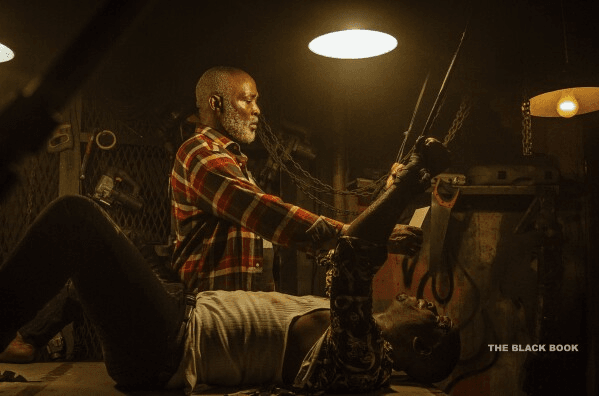
Paul’s involvement with a group of corrupt men, led by General Issa (Alex Usifo Omiagbo), who capitalized on drug trafficking from South America through West Africa to Europe and America to amass wealth, comes to light. A pact that lasted twenty-four years has been broken, and now, justice must take its course for peace to reign. The battle line is drawn between General Issa and Paul—the boss and his former loyal servant—after Paul refuses to accept a bribe. As Paul insists on justice, General Issa orders a fumigation: Paul must be framed as an enemy of the law and held accountable for the deaths of policemen.
To sail through the storm, Paul seeks the help of the mysterious Big Daddy. Their alliance brings new hope as Paul leaves no stone unturned in his quest to rescue Vic, who was kidnapped after his confession to her before Rev. Fr. Omotesho. Paul must fight not only to clear his son’s name but also to save Vic, whose survival represents his own redemption. All roads lead to Kaduna, where Paul and Big Daddy’s game plan outwits General Issa. With evidence out in the open, the narrative shifts: Paul, once the hunted, now becomes the hunter. Justice finds its way through atonement, championed by Vic (Victoria) Kalu. Finally, Paul’s act of burying his son symbolizes that nothing can stop a man determined to follow his purpose.
Characterization and Cast
The exceptional effort by Editi Effiong and the production crew in casting contributes significantly to The Black Book’s realism. There is strong synergy between the cast and their roles. Veterans like Richard Mofe Damijo (Paul Edima), Alex Usifo Omiagbo (General Issa), Shaffy Bello (Big Daddy), Sam Dede (Angel), Ireti Doyle (Commissioner), and others delivered stellar performances. Richard Mofe Damijo’s calm and firm nature fits perfectly with his leading role. A notable aspect is the striking resemblance between Richard Mofe Damijo and Joseph Momodu, who plays the younger Paul. This highlights the intentionality in the casting process.
The portrayal of Professor Craig, whose life was shattered in an instant following the kidnap and murder of her child and husband, effectively conveys profound emotional pain and loss. Vic’s role as a symbol of the average Nigerian youth demanding change is also significant. Her curiosity, discoveries, and actions reflect the determination of young Nigerians in their quest to revitalize the system.
Setting and Embellishment
The Black Book is set in Lagos and Kaduna. These locales enrich the narrative and allow for the exploration of Nigeria’s socio-political landscape. Lagos, a hub of commercial and industrial development, serves as the backdrop for much of the action, while Kaduna’s vast, arid lands provide the setting for the film’s climactic scenes. The contrast between the settings deepens the plot, reinforcing themes of class and morality.
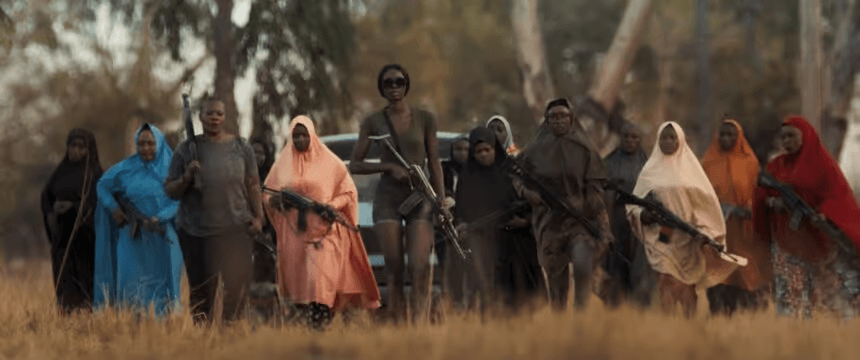
The film’s music, costumes, and cinematography reflect the observed improvement in Nollywood productions, adding realism and emotional depth to the film.
Dialogue
The predominant language used in The Black Book is English, with occasional code-switching into Yoruba and Hausa. Chief Daddy’s ability to fluidly switch between languages emphasizes her dominance and experience in her role.
Loopholes
Undoubtedly, The Black Book skillfully comments on the state of affairs in the country through Paul Edima’s quest for justice. However, certain areas could have been better developed. The major theme of justice, for instance, was not fully depicted. A more gradual and in-depth portrayal of Paul’s current life and his relationship with his son could have added emotional weight to his quest for justice.
The decision to hand Vic to Fr. Omotesho, who raised her from childhood, should be questioned. Given the Catholic priesthood’s nature, it would have been more fitting for the priest to place her in foster care. Additionally, the communication between characters, especially in the feud between Paul and General Issa, lacked clarity. The sudden appearance of Big Daddy at crucial moments needed more context, as it was unclear how she seemed to know about events in real-time.
The shooting scenes, while typical of most Nollywood, were subtly unrealistic. The lack of visible damages from the gunfire questions the credibility of those scenes.
On a religious level, The Black Book can be interpreted as a quest for redemption and revival. It emphasizes the importance of weighing decisions and their consequences. Paul Edima’s duality—being both a sinner and a saint—speaks to the complexities of human nature. The Black Book weaves a compelling narrative about one man’s pursuit of justice while exposing deep-rooted corruption within Nigerian society.