
Seven Doors is a six-episode fictional story set in a Yoruba kingdom, the Kingdom of Ilara, where socio-cultural issues intersect with individual struggles, raising existential questions about the hazards of leadership and the transgenerational repercussions of past deeds.
Storyline
Seven Doors revolves around a central conflict rooted in the clash between past actions and present desires. Oba Adedunjoye, with the support of his devoted wife, ascends to the throne of his ancestors. After passing all the necessary tests, he begins making critical decisions for the kingdom. However, surrounded by corrupt and greedy chiefs, his reign becomes fraught with enmity and contestation. Amidst this socio-political upheaval, the supernatural realm stirs its own chaos, bridging past and present.
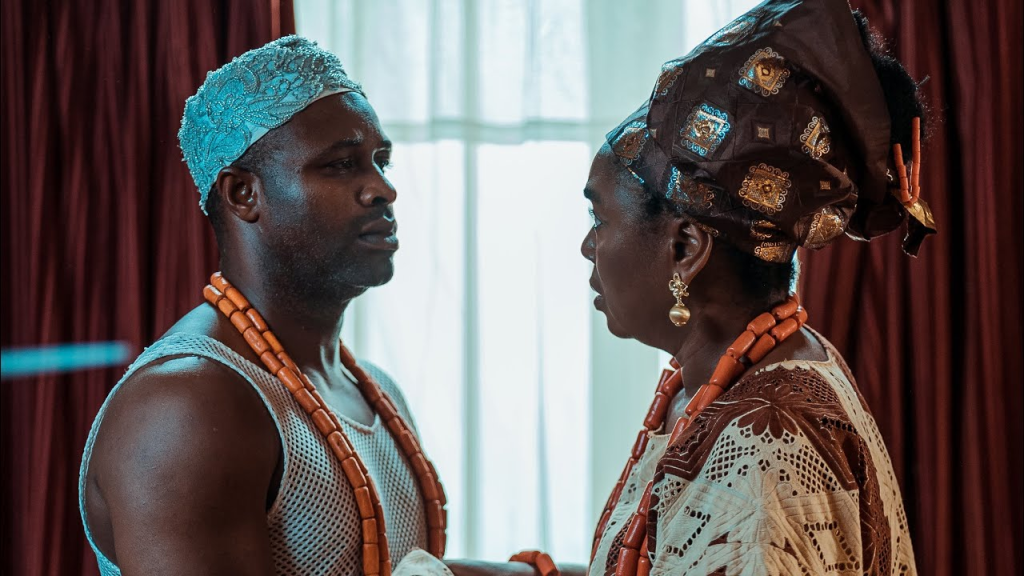
Oba Adedunjoye’s love for his wife and family faces grave danger as the consequences of his forefathers’ deeds are visited upon him, his lineage, and his people. To restore peace and progress to Ilara, he is compelled to open six more doors (marry six wives) and engage in a life-threatening battle with the deity Esusu.
Cast and Characterization
Produced by Femi Adebayo, Seven Doors features an impressive ensemble cast. The actors deliver commendable performances, showcasing their individual skills while driving the story’s themes and subject matter. The characters are well-crafted, contributing significantly to the film’s exploration of leadership, love, and the burden of history.
Blind Spots
The movie begins with a dramatic scene depicting the simultaneous suicide of seven women, seemingly under supernatural influence. However, as the plot unfolds, it becomes clear that the women died individually, in separate locations, and in full possession of their faculties. While this scene might have been intended to emphasize the supernatural realm’s influence on the physical world, its relevance feels diminished, and the execution—marked by exaggerated gory aesthetics—appears more magical than realistic.
The indefinite timeline in which Seven Doors is set also leaves viewers uncertain. While the costumes and props suggest a colonial-era setting, the lack of explicit clarification is problematic. Additionally, the depiction of “Old Ilara” lacks significant differentiation from present-day Ilara, aside from a cloudy effect in its cinematography.
The supernatural battles, including Oba Adedunjoye’s encounters in the mystical rooms, are rendered more magical than realistic. For instance, the Oba emerges from each fight bloodied yet unscathed, with no clear depiction of the actual clashes, reducing the believability of a mortal fighting supernatural forces.
Lastly, Prince Adeoye’s storyline is left unresolved. After his failed attempts to seize the throne through the chiefs and Opa Yemi, the audience is left wondering about the fate of his ambitions. This loose end creates another unresolved conflict.
In all, being full of actions, the lead character’s actions are more dramatic- too present as acting than an immersive make-believe.
Costumes and Props
The costumes, props, locations, and other aesthetics in Seven Doors serve as significant cultural markers, authentically representing the era and people. From traditional Yoruba hairstyles and Afro styles for men to old-fashioned plates, painted houses, the king’s carriage, vintage cars, and the initiation rooms, the film demonstrates attention to detail. The makeup effects for the supernatural beings, the coronation scenes, Igbo traditional attire, and the wedding scenes are deliberate and immersive, reflecting the filmmakers’ intentionality and commitment to authenticity.
Setting
Set in the 18th-19th century Kingdom of Ilara, Nigeria, Seven Doors effectively portrays the socio-political and cultural dynamics of the era. The spatial setting contributes significantly to the story’s believability.
Language
The film employs Yoruba as the primary language, with some code-mixing of English and Igbo. The richness of Yoruba culture is emphasized through proverbs, idioms, and traditional expressions, adding depth to the narrative.
Songs
Traditional Yoruba chants, eulogies, and the apàlá genre are richly utilized to accentuate the cultural essence of Seven Doors. Incantations and deity eulogies play a crucial role in the supernatural invocations, further immersing the audience in the film’s mystical dimension.
Seven Doors is a culturally rich and visually immersive exploration of Yoruba heritage, weaving themes of leadership, love, and the consequences of past actions. Despite some unresolved plot points and overly magical elements, the film’s compelling storyline, commendable performances, and attention to cultural detail make it a thought-provoking and engaging watch.