
Lísàbí holds a prominent place in Yoruba history as a revered hero and symbol of resistance against oppression. He is celebrated for his role in leading the Egba people’s revolt against the powerful Old Oyo Empire in the 18th century, which had imposed harsh tributes and subjected surrounding territories like Ìtòkú, Ìjàyè, Gbagùrá, Ìgbèyìn, Ìkérékú, Àké and many others to exploitation. Lísàbí’s strategic leadership and bravery became legendary when he united the Egba youth, organizing them to stand against the oppressive tribute collectors known as the Ilari, who served the Alaafin of Oyo.
His efforts not only sparked the famous Egba uprising but also marked a significant moment of defiance in Yoruba history, where a smaller, oppressed community stood up to a dominant empire. Lísàbí’: The Uprising is a re-enactment of this history.
Storyline
Lísàbí: The Uprising tells the complex political landscape of the Old Oyo Empire, where the Alaafin of Oyo wields immense power, both economically and politically. The state’s dominance extends far and wide, subjugating surrounding towns through oppressive measures. These territories are forced to pay isakole; royal tributes in the form of farm produce and money to the Alaafin of Oyo, who is also known as Oloyo by the Egba people. The tale delves into the terrifying reach of the Ilari, the Alaafin’s tribute collectors, commanded by the fearsome Sàngódèyí. Aided by the supply of guns by the Portuguese, the Alaafin of Oyo displays his unquestionable sovereignty and brutality by testing the efficiency of the gun on slaves. He dethrones kings and put towns into ruins.
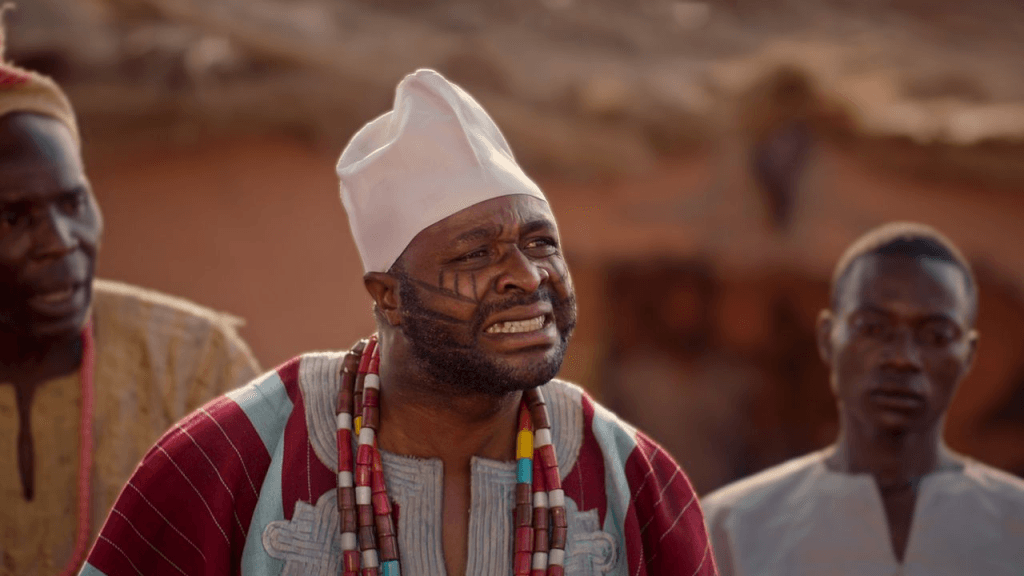
As the Ilari enforce the king’s oppressive policies, the Egba people endure brutal suffering, marked by deaths and the violation of their maidens. These atrocities spark deep outrage among the Egba youth. Their leader, Lísàbí, rises in defiance following the murder of his close friend Osokenu and the violation of Osokenu’s bride, Abebi by the tyrannical Sàngódèyí. In response, Lísàbí crafts a revolutionary strategy, introducing a system of collective farming where the youth work each person’s land in rotation. This strategy not only strengthens their unity but also earns Lísàbí the unwavering loyalty of the youth.

However, the king and elders of the Egba, suspicious of this growing solidarity, outlaw the teamwork initiative. Yet, by this point, Lísàbí has already secured a committed following within the youth leadership. Undeterred, he forges ahead with his rebellion, having fortified the youth with supernatural aid. Lísàbí confronts Sàngódèyí and his closest allies while other rebel groups, stationed across various locations, await his signal to rise. The questions that loom over the uprising are: Will Lísàbí’s revolt succeed? Will the Egba people finally break free from the grip of Oyo’s tyranny? And will Lísàbí and his loyal fighters survive to witness the dawn of their hard-fought liberation?
Cast/Characterization
The diversity of the cast reflects deliberate, non-stereotypical choices. For instance, it is surprising that Gabriel Afolayan, who plays Odunbamitefa, does not have a speaking role, although his presence, along with Olumide Oworu, is eventually noticed. The lead and supporting characters embody their roles, with many of them excelling in these types of portrayals.
Directed by Niyi Akinmolayan and written by Akinmolayan and Yinka Olaoye, Lísàbí: The Uprising stars Lateef Adedimeji as Lisabi Agbongbo Akala, Ibrahim Chatta as Sangodeyi, Adebowale Adedayo as Osokenu, and Odunlade Adekola as the Alaafin of Oyo (Oloyo). Femi Adebayo portrays Olu Olodan, Kola Ajeyemi stars as Akinolu, and Boma Akpore brings Osogbenro to life. Olumide Oworu plays Bejide, and Roseline Afije “Liquorose” takes on the role of Abebi. Adebimpe Adedimeji appears as Ikeola, while Efe Irele portrays Eye. Other notable roles include Jide Kosoko as Onitumọ and Muyiwa Ademola as Alake, among many others.

Setting
The opening of Lísàbí: The Uprising introduces the audience to the geographical landscape of the Old Oyo Empire and its surrounding towns. Set in Yorubaland, specifically in present-day Oyo and Ogun States, Nigeria, the film captures the political and economic rulership of the Oyo Empire. The setting is rich with rural scenery and cultural aesthetics, effectively reflecting the historical and vibrant atmosphere of the time.
Language
The use of language in Lísàbí: The Uprising is both obvious and commendable, as expected in a historical re-enactment. The Egba people’s distinct Yoruba intonation is evident, adding authenticity to the film’s portrayal. This aspect highlights the excellent casting and scriptwriting. Conversations among characters are filled with deep Yoruba idioms and proverbs, showcasing the richness of the language. Rarely is there a conversation without the use of these cultural expressions, which further demonstrates the brilliance and depth of Yoruba linguistic heritage.
Mystical Realities
The presence of mystical beings is pronounced, especially as Lísàbí: The Uprising includes a revolt against oppression by those in power. The depiction of these supernatural beings, and their surreal states as they are tasked with training and fortifying humans, opens up an aspect of history that deals with spiritualism. Consequently, these portrayals are left to the audience’s scrutiny and believability.
Cinematography
Nollywood’s advancements in cinematography are evident in Lísàbí: The Uprising, which delivers a five-star visual experience. The film is shot on a grand scale, with meticulous attention to detail. The camera strategically withdraws in scenes requiring make-up effects and reemerges when necessary to enhance believability. This approach makes the visual effects feel more authentic and seamless.

Costumes and Props
For a film like Lísàbí: The Uprising, cultural aesthetics and historical accuracy are crucial. The costumes and props reflect this necessity, featuring traditional attire, tribal marks, specific weapons, and other period-appropriate details. These elements contribute to the film’s believability and help immerse the audience in the historical context.
Songs
Lísàbí: The Uprising uses songs and sounds to convey its tone and mood effectively. The film features war songs, chants, eulogies, wedding songs, incantations, and other sounds that enhance the emotional impact of key moments. These auditory elements bring the actions and themes of the story to life, deepening the audience’s connection to the events on screen.
As the saga is set to continue, the storyline begs to remain captivating but for lovers of historical and cultural films, Lísàbí: The Uprising is a must-watch.